“Many people have asked why the shooter did what he did on December 14, 2012. Or in the vernacular of the criminal justice system, ‘Did he have a motive to do what he did?’ This investigation, with the substantial information available, does not establish a concrete motive.”
It’s been a year since the massacre at Sandy Hook, and the Connecticut State Attorney’s report on what happened on that December morning has been public since just before Thanksgiving. Its conclusion is simple: we cannot determine what drove Adam Lanza to murder twenty-six people, twenty of them children, at Sandy Hook Elementary School (SHES), or what led him to shoot his own mother earlier that morning. Though these events can be described at painstaking length, and documented in voluminous appendices, his actions remain unexplainable. And with that the investigation is closed.
But the fact of the matter is that not every mystery is equally unexplainable, or at least, that different mysteries can be unexplainable in different ways. Not even the most credentialed physicist can definitively explain what transpired in the first instants after the Big Bang, and even the most eloquent poet cannot explain what precisely happens inside of a person those first moments when they fall in love. But as thinking and feeling humans we are closer to some unexplainable mysteries than to others, and we can sense the shape and tone of the questions they raise even if we cannot diagram or recite their answers.
What might bring an individual to commit an act of horrific violence is unexplainable in a different way from why violence is a feature of the human condition in the first place. Even though contemplating one mystery easily slides into a meditation on the other, their different modes of unexplainability ramify in different registers – psychology and theology, respectively. In the case of Sandy Hook in particular, the impulse to invoke the unexplainable is understandably acute. If Adam Lanza’s room, with its windows covered in garbage bags, remains a dark spot, impenetrable to our vision, then how much more mysterious must we feel were the goings-on inside his head or on his hard drive – both of which he took care to obliterate?
But in the case of some black boxes, you can hear the shadows move within, and question what fuels their rustling.
In the eyes of the law, of course, and the question of motive aside, certain determinations can be made, cut and dried. On the morning of December 14, 2012, Adam Lanza, a twenty-year old man with a history of mental health issues, committed a minimum of thirty-eight felonies, actions that display clear premeditation. “It is clear that the shooter planned his crimes in advance and was under no extreme emotional disturbance for which there was a reasonable explanation or excuse.” Here, as in elsewhere in the report, there appears a co-determination between logics of explanation and exculpation, reason and blame. Though Lanza did the unthinkable, he clearly thought it through, and thus, presumably, if he had survived, he would have had – in the State’s eyes at least – no grounds for defense by reason of insanity.
Reading these passages, and others, it is hard not to perceive in the Report a tension between competing logics of explainability and accountability. “It is known that the shooter had significant mental health issues that affected his ability to live a normal life and to interact with others, even those to whom he should have been close. As an adult he did not recognize or help himself deal with those issues.” To those he should have been close. What does this mean? As early as 2005-2006, Lanza received a diagnosis of comorbid Asperger’s, Obsessive-Compulsive, and Pervasive Developmental Disorders – does this “should have been” reference his inability to achieve certain psychological milestones, specifically those prescribed by psychiatry? And yet: As an adult he did not recognize or help himself deal with those issues. This seems to suggest a rather different kind of failure – a moral one, an inability to take responsibility for himself. Without excusing Lanza for what he did that day in December, we must acknowledge that our effort to explain what led up to those events seems motivated, at least in part, by a desire to locate and judge previous moral failings, some sequence of transgressions that prefigured them.
To those he should have been close. By all accounts the person closest to Adam Lanza was his mother, Nancy. Demonstrating an even further conflicted concern for adjudicating both explanation and blame than it does in its treatment of Adam, the Report argues that Nancy was unaware of her son’s plans and thus not legally culpable as an accessory while sidestepping questions of her potential negligence in providing her son with access to weapons and training and even giving him guns of his own. To be clear: in addition to “many edged weapons, knives, swords, spears, etc.,” there were at at minimum five guns in the Lanzas’ Sandy Hook home – the two pistols, combat shotgun, and Bushmaster XM-15 which he took with him to SHES that morning in addition to the rifle with which he shot Nancy four times in the head while she slept. Although I find vilifying Nancy Lanza distasteful, with the release of this report some assumptions of solidarity with her in the immediate aftermath of the shootings now seem woefully premature. How many mothers — or fathers — would surround a son like Lanza with weapons, or would cut him a check as a Christmas gift, writing in the memo that the money was to be used to buy yet another semiautomatic? And this despite the fact that, as the reporter notes: “The shooter disliked birthdays, Christmas and holidays. He would not allow his mother to put up a Christmas tree. The mother explained it by saying that shooter had no emotions or feelings.”
Far be it from me to judge the moral landscape of parenting a child as distant as Adam Lanza appears to have been, let alone how one would navigate doing so as a single mother, whatever your financial resources. I can only begin to imagine the yearning for connection with a son who does not appear to return your love, who won’t even let you touch him, how that void builds over years and years and leaves you desperate for something, anything, to share with him — to the point where you embrace and celebrate his mastery of technologies of death as at least one thing, the only thing, that you can share. But, Christ in Heaven, if your son makes explicit to you that he doesn’t care if you live or die, if you yourself are the first to say that he has no positive emotions whatsoever, if he collects videos of people shooting themselves and murdering others, if he tells those who ask that his own life is worthless, why, why, why would you keep giving him guns as gifts? What possibilities are you entertaining or even encouraging, consciously or otherwise, not just in terms of what might happen to your son, but to you? And does it ever rise to the surface of awareness, if only for a moment, that the catastrophe which you are courting may consume not just you and your child, but so many others as well?
These are all questions, not explanations, already far too many for this space, but to them I must add just one more. Nowhere is the Report more suggestively candid in acknowledging what it cannot explain than when it addresses Lanza’s choice of target. “The first question was whether the shooter had a reason specifically to target SHES or any student, teacher, or employee. No evidence suggests that he did. In fact, as best as can be determined, the shooter had no prior contact with anyone in the school that day. And, apart from having attended the school as a child, he appears to have had no continuing involvement with SHES.”
Apart from having attended the school as a child. The shortness of this clause belies the length of time Lanza spent there: nearly a quarter of his entire life.
In literary and linguistic circles, you may occasionally run across the phrase “hapax legomenon.” It’s a Greek term, literally meaning “something said once,” and is used to refer to a word or phrase that only occurs once in a given literary text or linguistic corpus. In the Sandy Hook Report, one word in particular only occurs twice – which technically makes a “dis legomenon,” but since the referent in both cases is the same, and they show up on the same page, the singularity remains. That word is “love,” and it appears when the report turns to Adam Lanza’s experiences as a child at Sandy Hook Elementary School. “The shooter indicated that he loved the school, and liked to go there…He loved music and played saxophone.”
But then: “In 2006, the shooter’s mother noted that there were marked changes to the shooter’s behavior around the seventh grade. Prior to that, he would ride his bike and do adventurous things such as climbing trees or climbing a mountain. He had stopped playing the saxophone. He had been in a school band but dropped out. He had withdrawn from playing soccer or baseball which he said he did not enjoy.”
What happened to Adam Lanza? What changed the boy who loved his school into the young man who returned there to destroy it? What changed the boy who loved music and playing his instrument into someone who couldn’t tolerate even the sound of a barber’s razor or a lawn mower outside? What changed him from a boy who didn’t mind climbing trees and bruising his knees into one who would go through a box of tissues a day to avoid touching metal doorknobs? And what changed him from all these things into a man who strode, breathing calm despite the ear-splitting rapport of his assault rifle, as he mowed down a score of children in mere minutes?
These are the questions the unexplainable brings. Beyond that, all we have is wreckage, and grief.
————————————
Note: There are numerous points in which the report is elliptical and where even on the third or fourth reading certain details remain hard to pin down (for example, the exact number of weapons in the Lanza home). I’m thus glad to amend or correct anything I’ve gotten wrong, and I would certainly be eager for clarity on these details and others if someone else can provide them.
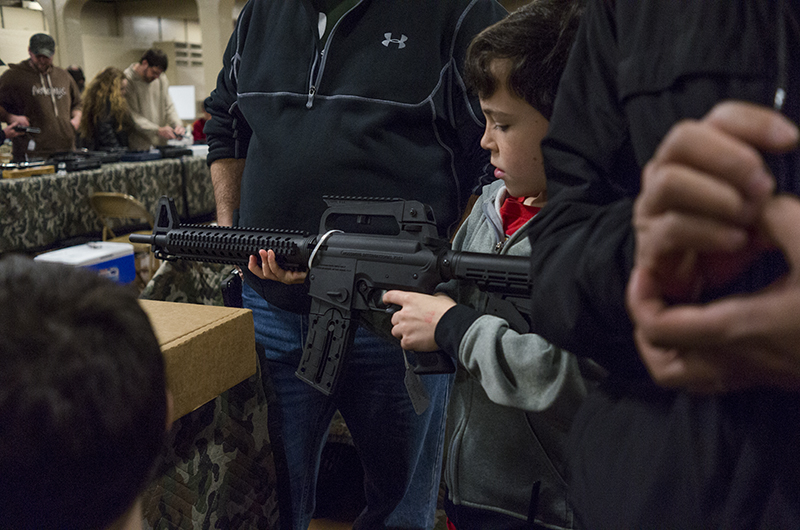
The photo which accompanies this piece is the work and property of my friend and collaborator Jason Francisco. You can view it, more from that series, and some of Jason’s other, fantastic work, here: http://bit.ly/1bfDjtE.
Updated for Clarity, 12/14
 Carte Blanchfield