Author Archives: Pat Blanchfield

Shelter in Place

Starting a new week, let’s take a brief moment to reflect on the one just past. Monday, Tuesday, Wednesday, Thursday, Friday – on each day, a High School or college campus somewhere across this country was either locked down because of reports of an active shooter or because of an actual shooting (two of which were fatal). On Saturday, a mass shooting in Columbia, Maryland, that left three dead and five injured, while in Baltimore proper, the murder rate is now just about one per day. And if you’ll look, you’ll find that Sunday was marked by violence too – not least in Pine Bluff, Arkansas, where a group of local Pastors who had planned on marking the day as “Justice Sunday” and preaching against community gun violence did so as local police put in weekend hours investigating a triple shooting.

This is our normal, now.

On Twitter yesterday, the writer Jessica Luther of the Atlantic noted that, of the Columbia victims, one, Brianna Benlolo, was only 21 years old, and leaves behind a two-year old child. “There’s apparently no story tragic enough to create change RE: gun control laws,” observed Luther.

This is simply true, on the face of it. If the story of twenty toddlers mowed down within minutes in a wealthy Connecticut suburb can’t galvanize policy change in this jaded nation, then no story will.

No stories, no matter how tragic, will change anything, because this is how we’ve decided, collectively, to live. Or at least, it’s how some of us have decided that we are to live, with some of us living it more than others.

Stories are vital. But stories – no matter how heartbreaking – won’t end structural violence and broken lawmaking.  Either we confront our national history of violence, the way our culture is steeped in it – or we don’t.  Either we confront industry capture of our legislature, the ability of an extremist minority and the corporate interests that encourage them to overrule common sense and majority sentiment – or we don’t.

But for those of us who believe in the power of stories – and I’m one of them – maybe, also, there’s a place for talking about those structures in terms of stories, however crude.

A nation built with guns, under the sign of guns, is consumed by them. America’s ballistic growth has reached its limits, can go no further, and now turns in on itself. What gave us our manifest destiny now claims our future, robs us of our children in brutal atavism.

But: “Our” future. “Our” children. “Us.”

Therein also lies the problem.

Because some of the people who live on this continent, in this place, have been losing their children to this thing for much, much longer than others. And some people who once lived here are just gone because of it. Gone. Children, parents, entire peoples. Just gone.

Who are we to think we can live without this touching us? Do we really believe this?

We built this country – built “us” – on the premise that an economy of violence can maintain a strict logic of externalities, brutally enforced borders between oppressors and oppressed, settlers and natives, masters and slaves, citizens and non-. But violence doesn’t work that way, on principle, and definitely not in our crowded, contentious democracy. Violence cannot be contained. And there is no external, no outside anymore. Not here, not in this place, not within us.

So we go to the mall. We go to work. We take our kids to school. We wait for the bus. We walk across campus. We take in a movie. We sleep in our beds.

We shelter in place.

But there is no shelter.

Not in this place.

Not Just For My Son

Earlier this week, I attended a Town Hall event in East Atlanta organized by State Senator Vincent Fort and a suite of community groups. The event focused on repealing Georgia’s Stand Your Ground legislation (SYG; GC 16-3-21) and was a deeply powerful experience.

Lucia McBath

Lucia McBath

Of the many phenomenal speakers that night, one in particular downright tore the roof off with her heartbreaking story and raw power: Lucia McBath, the mother of Jordan Davis, a 17 year-old boy who was shot to death while sitting in a car with some friends in a gas station parking lot in Florida. Davis’ killer, Michael Dunn, a 46-year-old white man, apparently felt that the boys’ “thug music” was threatening, and when the boys refused to turn it down, he emptied the clip of his handgun into the vehicle. Dunn, who had allegedly been drinking heavily at the time, is pursuing a modified SYG defense because he claims he believed he saw one of the boys inside the car reach for a shotgun. Dunn immediately fled the scene; no such weapon was ever found.

McBath, whose father was for two decades the President of the Illinois NAACP, spoke movingly about how she had raised her son. “My son was taught and trained to stand up for himself, and he told Dunn they weren’t bothering anyone and that if he had a problem he could just roll his windows up… And Dunn, because they didn’t do what he told them, empowered by his gun, he fired ten rounds into the car and three of those bullets instantly killed my son.” McBath – whose bravery is humbling and inspiring and profound – ended her speech with a plangent appeal for recognition, for action: “I feel in my heart at times that I am a lonely warrior. That no one hears me. I am begging you to hear me. Not just for my son, but for Trayvon, for Sandy Hook, for so many…This has to end.”

As McBath spoke, people yelled back – “We hear you! We hear you!” – and when the speaker asked for folks to pledge to sign petitions and march and call the Governor the audience response was tremendous. We held hands and prayed and sang and I for one walked out with faith in the capacity of righteous people in numbers to do good, to effect change. And I think these people will.

But then I got home and read an article in Mother Jones and it made me ill. It’s by a reporter named Josh Harkinson, and you should read it – it’s not long. In quick summary: Bushmaster Firearms International, the company which makes the XM-15, the AR-style assault rifle Adam Lanza used in the Sandy Hook massacre last year, is a subsidiary of a company called the Freedom Group (AKA Remington Outdoor Company Inc.), which is in turn a property of Cerberus Capital Management, LP, a private equity firm that possesses nearly $20 billion in assets. Immediately after the shootings in Newtown, and in the face of public outcry, Cerberus pledged to liquidate its holdings in Freedom Group. A year later, it still hasn’t. Why not? Well, in large part, it’s because Freedom Group and Bushmaster are making more money than ever before. As Harkinson explains: “Between January and the end of September, the company raked in $94 million in profits on more than $1 billion in gun and ammo sales, compared with just $500,000 in net profits during the same period in 2012… According to the Freedom Group’s third quarter report, this year’s earnings spike came primarily from a $42 million bump in sales of “centerfire rifles,” a category which includes the XM-15.”

There is so much wrong here. Setting aside some of the more obscene ironies that Harkinson’s on-point reportage highlights (for example, the fact that the California State Teachers Retirement System continues to hold a $750 million dollar stake in Cerberus) the picture that emerges is of deep structures of power and embedded interests that stretch across multiple institutions, private, public, non-profit, and more – with the NRA serving, as it so often does, as the nexus at the heart of things. Because, of course, the folks who call the shots – so to speak – at Freedom Group are heavily represented on the NRA’s Nominating Committee, arguably the most important decision-making body in that institution, and as individuals are major donors to the NRA (in fact, they’re in the “Golded Ring of Freedom” club of million-dollar-plus contributors). And it’s not a far step from that, either, to note the confluences of interest and lobbying activities that link the NRA and the right-wing, corporate-sponsored American Legislative Exchange Council (ALEC) – whose activities in promulgating SYG laws in conjunction with the NRA are a matter of public record.

My goal here isn’t to sketch out an org chart, nor to sniff out (not-so) secret pathways of converging interests, nor to finger individuals for blame – although there are plenty of folks in this story who deserve public shame (not that they give a damn about it). Instead, I want to make an observation, at once structural and personal, about our contemporary moment.

The continued, outrageous profits raked in by Bushmaster and the insulation of Cerberus in its hypocritical efforts to placate public scorn, combined with the successful legislative advocacy of industry-sponsored groups like ALEC – including but not limited to SYG – represent a twisted state of affairs that is at once classic American capitalism at its worst but also something  uniquely of our 21st Century moment. Industries manufacturing products that hurt people, making money hand over fist in the process, and then successfully protecting their interests through shaping legislation are as old as this country itself, as is the pervasive enmeshment of all our financial activities, however ostensibly benign they may seem, in such activities. But the degree of legislative power today’s firearms industry wields – power, I think, rivalling that of players in the financial sector – has no parallel with any other group thanks to the added element of its frankly ludicrous claim to uniquely patriotic standing and a misbegotten Constitutional warrant that has been twisted and deformed beyond all recognition by those with a financially motivated interest to do so.

But of course that’s not all of it. It’s not just about lobbyists and lawyers and businesspeople gaming the legislative system, shamelessly declaring their best intentions, and piously gesturing at doing the right thing even as they continue to enrich themselves. It’s about selling people fear, about cultivating their fears to stoke marketplace demand, and about enabling their clientele to act those fears out in the most violent ways imaginable.

Let’s get real: there are gun manufacturers and retailers who don’t mind mobilizing insurrectionist fantasies and white supremacist irredentism to move their product. That’s part of their business model. And not just that: they’ve acted, successfully, to change our legislative landscape so that when their clients act on those fears and kill others – children, even – both the killers and their enablers face no blowback whatsoever. Instead, they profit.

And let’s get even realer: if our society – with all its hideous double standards – does nothing – nothing, nothing, nothing – when twenty toddlers, nearly all of them white, and in a wealthy community in the Northeast to boot, are slaughtered, mercilessly – what in the name of God  would ever drive us to action?

“I am begging you to hear me. Not just for my son, but for Trayvon, for Sandy Hook, for so many…This has to end.”

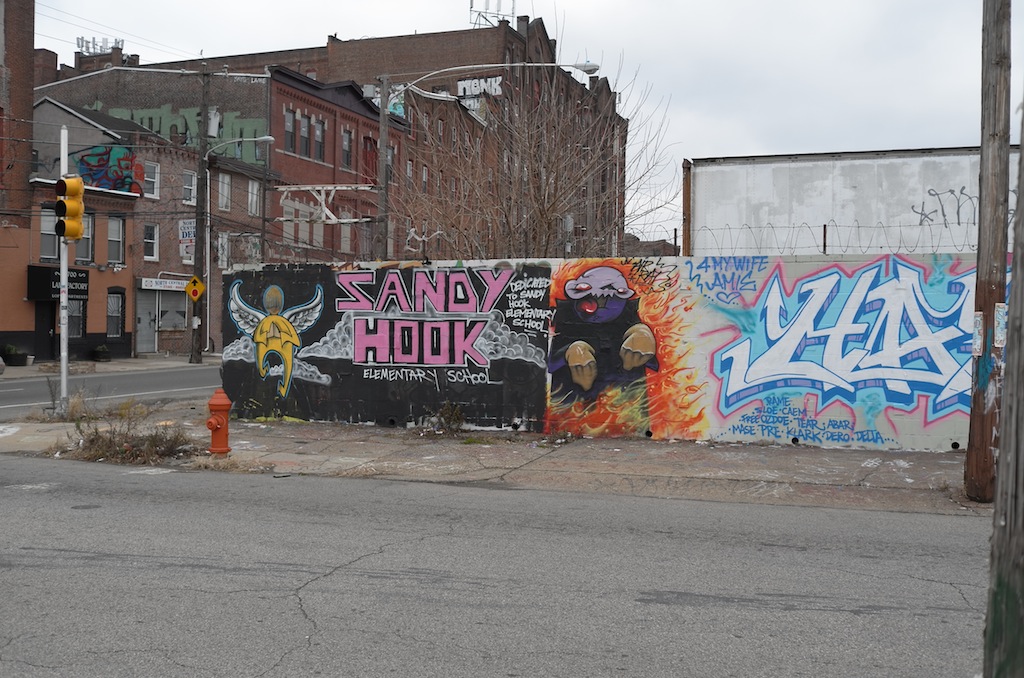
COPYRIGHT JASON FRANCISCOMy friend and frequent collaborator Jason Francisco does work photographing graffiti memorials to murder victims in the most blighted parts of North Philly – walking so-called “murder corridors” with his Leica. New memorials go up every week, sometimes, every day. So many. So many kids. Last year, he took a picture of a massive one, on the Corner of 5th and Cecil B. Moore. The mural stretches up and down, easily six feet tall, sprayed lovingly on a cinderblock wall mounted with barbed wire.  A childlike angel, faceless, its hands clasped in prayer, floats next to the epitaph: “Dedicated to Sandy Hook Elementary School.” Sending the photo to me, Jason remarked: “I hope there is an equally enlightened graffiti writer in Newtown, CT who remembers the victims of gun violence in Philadelphia.”

I’m not a gambling man, but I’m willing to make my bets on that one.

That Town Hall event earlier this week was powerful. It left me feeling hope and conviction. I still feel those things, and believe that SYG can be repealed, and my heart and solidarity is with those who fight towards that end. But against forces so powerful, against exploitation and oppression so thorough and vile and total – beyond simply repealing laws but to changing attitudes, to changing our culture, to changing our way of life – what is to be done? I wish I knew. But I do know that we have to try.

———-

Note: I didn’t bring an audio recorder with me to the SYG event, and am working from my handwritten notes. If I’ve gotten any of the quotes – or any other details wrong – please let me know, and I will amend this accordingly. As always, the same goes for the rest of the content in this piece.

If you want read more about the NRA Board, you can do so here. If you want to learn more about the geographic breakdown of gun violence in America’s inner cities, I recommend this article.

Jason Francisco’s photoseries on Philadelphia’s Murder Corridors, “These Are the Names” is available here. It’s really worth checking out.

The Shooter

Copyright Jason Francisco

“Many people have asked why the shooter did what he did on December 14, 2012. Or in the vernacular of the criminal justice system,  ‘Did he have a motive to do what he did?’ This investigation, with the substantial information available, does not establish a concrete motive.”

It’s been a year since the massacre at Sandy Hook, and the Connecticut State Attorney’s report on what happened on that December morning has been public since just before Thanksgiving. Its conclusion is simple: we cannot determine what drove Adam Lanza to murder twenty-six people, twenty of them children, at Sandy Hook Elementary School (SHES), or what led him to shoot his own mother earlier that morning. Though these events can be described at painstaking length, and documented in voluminous appendices, his actions remain unexplainable. And with that the investigation is closed.

But the fact of the matter is that not every mystery is equally unexplainable, or at least, that different mysteries can be unexplainable in different ways. Not even the most credentialed physicist can definitively explain what transpired in the first instants after the Big Bang, and even the most eloquent poet cannot explain what precisely happens inside of a person those first moments when they fall in love. But as thinking and feeling humans we are closer to some unexplainable mysteries than to others, and we can sense the shape and tone of the questions they raise even if we cannot diagram or recite their answers.

What might bring an individual to commit an act of horrific violence is unexplainable in a different way from why violence is a feature of the human condition in the first place. Even though contemplating one mystery easily slides into a meditation on the other, their different modes of unexplainability ramify in different registers – psychology and theology, respectively. In the case of Sandy Hook in particular, the impulse to invoke the unexplainable is understandably acute. If Adam Lanza’s room, with its windows covered in garbage bags, remains a dark spot, impenetrable to our vision, then how much more mysterious must we feel were the goings-on inside his head or on his hard drive – both of which he took care to obliterate?

But in the case of some black boxes, you can hear the shadows move within, and question what fuels their rustling.

In the eyes of the law, of course, and the question of motive aside, certain determinations can be made, cut and dried. On the morning of December 14, 2012, Adam Lanza, a twenty-year old man with a history of mental health issues, committed a minimum of thirty-eight felonies, actions that display clear premeditation. “It is clear that the shooter planned his crimes in advance and was under no extreme emotional disturbance for which there was a reasonable explanation or excuse.” Here, as in elsewhere in the report, there appears a co-determination between logics of explanation and exculpation, reason and blame. Though Lanza did the unthinkable, he clearly thought it through, and thus, presumably, if he had survived, he would have had – in the State’s eyes at least – no grounds for defense by reason of insanity.

Reading these passages, and others, it is hard not to perceive in the Report a tension between competing logics of explainability and accountability. “It is known that the shooter had significant mental health issues that affected his ability to live a normal life and to interact with others, even those to whom he should have been close. As an adult he did not recognize or help himself deal with those issues.” To those he should have been close. What does this mean? As early as 2005-2006, Lanza received a diagnosis of comorbid Asperger’s, Obsessive-Compulsive, and Pervasive Developmental Disorders – does this “should have been” reference his inability to achieve certain psychological milestones, specifically those prescribed by psychiatry? And yet: As an adult he did not recognize or help himself deal with those issues. This seems to suggest a rather different kind of failure – a moral one, an inability to take responsibility for himself. Without excusing Lanza for what he did that day in December, we must acknowledge that our effort to explain what led up to those events seems motivated, at least in part, by a desire to locate and judge previous moral failings, some sequence of transgressions that prefigured them.

To those he should have been close. By all accounts the person closest to Adam Lanza was his mother, Nancy. Demonstrating an even further conflicted concern for adjudicating both explanation and blame than it does in its treatment of Adam, the Report argues that Nancy was unaware of her son’s plans and thus not legally culpable as an accessory while sidestepping questions of her potential negligence in providing her son with access to weapons and training and even giving him guns of his own. To be clear: in addition to “many edged weapons, knives, swords, spears, etc.,” there were at at minimum five guns in the Lanzas’ Sandy Hook home – the two pistols, combat shotgun, and Bushmaster XM-15 which he took with him to SHES that morning in addition to the rifle with which he shot Nancy four times in the head while she slept. Although I find vilifying Nancy Lanza distasteful, with the release of this report some assumptions of  solidarity with her in the immediate aftermath of the shootings now seem woefully premature. How many mothers — or fathers — would surround a son like Lanza with weapons, or would cut him a check as a Christmas gift, writing in the memo that the money was to be used to buy yet another semiautomatic? And this despite the fact that, as the reporter notes: “The shooter disliked birthdays, Christmas and holidays. He would not allow his mother to put up a Christmas tree. The mother explained it by saying that shooter had no emotions or feelings.”

Far be it from me to judge the moral landscape of parenting a child as distant as Adam Lanza appears to have been, let alone how one would navigate doing so as a single mother, whatever your financial resources. I can only begin to imagine the yearning for connection with a son who does not appear to return your love, who won’t even let you touch him, how that void builds over years and years and leaves you desperate for something, anything, to share with him — to the point where you embrace and celebrate his mastery of technologies of death as at least one thing, the only thing, that you can share. But, Christ in Heaven, if your son makes explicit to you that he doesn’t care if you live or die, if you yourself are the first to say that he has no positive emotions whatsoever, if he collects videos of people shooting themselves and murdering others, if he tells those who ask that his own life is worthless, why, why, why would you keep giving him guns as gifts? What possibilities are you entertaining or even encouraging, consciously or otherwise, not just in terms of what might happen to your son, but to you? And does it ever rise to the surface of awareness, if only for a moment, that the catastrophe which you are courting may consume not just you and your child, but so many others as well?

These are all questions, not explanations, already far too many for this space, but to them I must add just one more. Nowhere is the Report more suggestively candid in acknowledging what it cannot explain than when it addresses Lanza’s choice of target. “The first question was whether the shooter had a reason specifically to target SHES or any student, teacher, or employee. No evidence suggests that he did. In fact, as best as can be determined, the shooter had no prior contact with anyone in the school that day. And, apart from having attended the school as a child, he appears to have had no continuing involvement with SHES.”

Apart from having attended the school as a child. The shortness of this clause belies the length of time Lanza spent there: nearly a quarter of his entire life.

In literary and linguistic circles, you may occasionally run across the phrase “hapax legomenon.” It’s a Greek term, literally meaning “something said once,” and is used to refer to a word or phrase that only occurs once in a given literary text or linguistic corpus. In the Sandy Hook Report, one word in particular only occurs twice – which technically makes a “dis legomenon,” but since the referent in both cases is the same, and they show up on the same page, the singularity remains. That word is “love,” and it appears when the report turns to Adam Lanza’s experiences as a child at Sandy Hook Elementary School.  “The shooter indicated that he loved the school, and liked to go there…He loved music and played saxophone.”

But then: “In 2006, the shooter’s mother noted that there were marked changes to the shooter’s behavior around the seventh grade. Prior to that, he would ride his bike and do adventurous things such as climbing trees or climbing a mountain. He had stopped playing the saxophone. He had been in a school band but dropped out. He had withdrawn from playing soccer or baseball which he said he did not enjoy.”

What happened to Adam Lanza? What changed the boy who loved his school into the young man who returned there to destroy it? What changed the boy who loved music and playing his instrument into someone who couldn’t tolerate even the sound of a barber’s razor or a lawn mower outside? What changed him from a boy who didn’t mind climbing trees and bruising his knees into one who would go through a box of tissues a day to avoid touching metal doorknobs? And what changed him from all these things into a man who strode, breathing calm despite the ear-splitting rapport of his assault rifle, as he mowed down a score of children in mere minutes?

These are the questions the unexplainable brings. Beyond that, all we have is wreckage, and grief.

————————————

Note: There are numerous points in which the report is elliptical and where even on the third or fourth reading certain details remain hard to pin down (for example, the exact number of weapons in the Lanza home). I’m thus glad to amend or correct anything I’ve gotten wrong, and I would certainly be eager for clarity on these details and others if someone else can provide them.

The photo which accompanies this piece is the work and property of my friend and collaborator Jason Francisco. You can view it, more from that series, and some of Jason’s other, fantastic work, here: http://bit.ly/1bfDjtE.

Updated for Clarity, 12/14
Shiwu Mulls Things Over, Wang Wei Goes on a Hike

After yesterday’s holiday excesses, some Classical Chinese poetry seems like just what the doctor ordered. Granted, these verses may not cure your hangover, but a dose of Chan (Zen) sensibility is about as good a counterpoint to the unfolding insanity of Black Friday as anything else I can think of. First, here’s an untitled poem by Shiwu (石屋), a Yuan-dynasty poet and hermit.

Somebody asks me when I first came to live here –
I sit in meditation until the answer comes:
the peachtree my hands planted outside my door
has come to blossom some twenty springs.
有人問我何年住
坐久纔方省得來
門外碧桃親手種
春光二十度花開

Here’s another one, by Wang Wei (王維), hands down my favorite poet in the canon. It’s an example of the classic eight-line, five-character-per-line lushi  (律詩) form and is, I think, the most beautiful piece to appear in the seminal Three Hundred Tang Poems (唐詩三百首) collection. The title, “Passing Xiangji Temple” (過香積寺) refers to a Pure Land sanctuary some fifteen miles from old Chang’an, and the motif of passing-by, of peripheral encounter, suggestively recurs and builds throughout the piece. In fact, it’s unclear from the very first line if Wang Wei actually physically gets to the temple – whether he ‘knew’ or ever got to ‘know’ it remains one of those undecidable things that makes Classical Chinese such evergreen fun to render into English.

I did not know Xiangji Temple.
I moved beneath many li of low clouds
old trees and deer runs
from deep in the mountain, somewhere, the sound of a bell
the muffled call of a swallow from beyond the rocks
the sun’s cold white on the blue pines.
In the evening, at the bend of a mountain stream,
I sit in meditation and tame the poison dragons of mind.
不知香積寺
數里入雲峰
古木無人徑
深山何處鐘
泉聲咽危石
日色冷青松
薄暮空潭曲
安禪制毒龍

In addition to my own halting versions, you can find these poems and many more like them in various places; I recommend this volume and this one, both put into English by Bill Porter (“Red Pine”), who in addition to being a superlative translator is also just a lovely person and great poet in his own right.

Riding Shotgun with George Zimmerman

So as you doubtless already know George Zimmerman was arrested again on Monday; he just bailed out today. He faces domestic violence charges for, among other things, allegedly threatening his pregnant girlfriend, Samantha Scheibe, with a shotgun. In case you’re keeping score and counting arrest records, that’s George Zimmerman, 4, Trayvon Martin, 0, with all of George’s arrests involving charges of violence.

Our understanding of what happened between Scheibe and Zimmerman is still unfolding, but the yesterday’s 911 tapes are deeply suggestive. You can hear them along with great analysis by Joy Reid and others as the first item on the archive of last night’s Last Word. A lot jumps out – not least of which being Zimmerman’s chilling sangfroid and the legal/PR savvy he demonstrates in his own call to a 911 operator. You may also notice that Zimmerman appears to be very, very well armed – his girlfriend claims he has at least two handguns, an AR, and the shotgun with which he allegedly smashed some of her possessions and furniture.

It’s that last weapon that I want to call your attention to. Scheibe identifies it as made by KelTec. KelTec is based in Florida, and it only produces one shotgun – the KSG. The KSG is a new, futuristic-looking 12 gauge intend for tactical use – the tightly compact ‘bullpup’ configuration is designed to help the user move it efficiently through close quarters, around doors, etcetera, and this feature plus the 15-round capacity is I suppose helpful if you’re part of a SWAT team clearing a room or a civilian who fears, however implausibly, having to defending your home in an all-out firefight.

At which point it’s worth nothing that since Zimmerman wasn’t able to actually hack it as a police officer and thus has never been nor ever will be in the former category, he apparently belongs in the latter, which shouldn’t be surprising to anyone at this point.

Anyway, folks love them their KSGs – here’s video of someone going to town with one. You can wield a virtual KSG while playing Call of Duty. They’re so popular that they frequently sell out, and when they do sell, go for well over the initially pitched MSRP of circa $800.  It’s perhaps because they can be hard to come by in this crowded market that just this past August George Zimmerman visited the KelTec plant to inquire about acquiring one – and apparently received a guided tour of the grounds from the owner’s son. He also mugged for photos with KelTec employees.

This brings me to some questions.

First, did Zimmerman acquire this shotgun during that visit – was it perhaps even given to him as a gift by KelTec? Did a KelTec employee – perhaps even the same bigwigs who feted him while there – sell it to him? You can transfer guns to people with incredible ease in Florida – did some kind of transaction of that order happen here?

Second, even if Zimmerman didn’t receive the gun with which he allegedly threatened his partner directly from anyone affiliated with KelTec, what, combined with the visit in August, does this latest development say about KelTec – what might it mean in PR terms? What kind of endorsement was KelTec looking for when they let Zimmerman gladhand for photos in their plant – and what did they endorse when they let him in?

And here’s my third and last question. What does it mean when an alleged domestic abuser and indisputable child killer becomes the poster child for a company that elsewhere tries to pitch ads like this one?

Image

On Shellie Zimmerman, the Guns of Patriarchy, and American Double Standards

Via the redoubtable Tressie McMillan Cottom, I came across this phenomenal piece by Robert Reece at Still Furious and Brave. It’s called Shared Victimhood and Redemption Through Racism and is about the similarities between Shellie Zimmerman, the soon-to-be ex-wife of the killer of Trayvon Martin, and Carolyn Bryant, the wife of one of the murderers of Emmett Till.

Like Bryant, who stood by her husband during his trial, Shellie Zimmerman aided her husband in his — to the point of committing perjury. Also like Bryant, who went on to divorce her husband, Shellie Zimmerman is now seeking separation from hers. And in her bid to divorce him – and presumably also to gain some media exposure – Shellie Zimmerman is invoking his killing of Martin much in the same way as Carolyn Bryant did her husband’s killing of Till: as evidence of her abusive partner’s capacity for violence.

In other words, both represent cases of (white) women leveraging their husband’s killing of  black children — outrages that went shamefully unredressed by the criminal justice system — in bids to claim victim status and exert their own right to vindication and compensation in a court of law. As Reece devastatingly puts it: “Zimmerman and Bryant opportunistically use the boys’ murders as proof of their husbands’ capacity for abuse when they benefit from shared victimhood, but they uphold their husbands in court through their testimony when they seek to defend white supremacy.”

Reece’s piece is absolutely on-point and raises a ton of deeply complicated, nuanced questions. Without gainsaying the legitimacy of Bryant and Zimmerman’s status as victims of domestic violence, Reece forces us to confront not just the irreducibility of different experiences of suffering modes of white patriarchal oppression — violence against women versus violence against non-whites and blacks in particular — but also the ways in which the former exists in relation to the latter. What are we to make of a situation wherein white women — who are undeniably victims of violence and oppression themselves — can capitalize on the undeniable, unavenged victimization (murder!) of black children as a means of liberating themselves from the immediate violence of white patriarchy in their households — while simultaneously doubling-down on and reinforcing its injustice?

The women themselves seem quite aware that this situation is a delicate one. Their tarrying with white patriarchal violence requires what Reece calls a “colorblind abuse picture” – both Zimmerman and Bryant “openly wonder about the details of each event, but they stop short of saying that the murders were racially motivated or that their husbands should have gone to prison.” They must do this not just because the analogies between themselves and the boys their husband killed is deeply faulty — they are alive and advocating for themselves in the court of law, not dead and failed by the justice system — but also because, on a much deeper level, the narrative of the potential victimization of white women is constantly marshaled as a pretext for violence against black males. As Reece puts it, “If they [Zimmerman and Bryant] chose to acknowledge the racialized elements of their husbands’ actions they would be forced to come to terms with the fact that they are responsible as white men’s violent outbursts against people of color are often patriarchal attempts to protect white women.”

I think this is totally right. The narrative of white women qua potential victims of black male violence — a fantasized, imaginary, paranoid fear that says more about the white men who cultivate and are dominated by it than it does about actual day-to-day reality — is indeed deeply ingrained in American history (as Reece himself has chronicled). Moreover, and here’s where my own research interests come into play – this narrative is also, I think, pervasive in much of contemporary American gun culture.*

It is a manifest but frequently under-appreciated fact that the dominant contemporary “Second Amendment advocacy” / firearms industry lobbying group – the National Rifle Association – owes its current, aggressively far-right incarnation to an organizational transformation in the late 1970s that was driven in large part by a rise in crime rates and white fear of nonwhites and of  urban blacks in particular. Moreover, the man who more or less singlehandedly engineered that transformation – Former NRA President Harlon Carter – was himself responsible for shooting and killing a 15-year old Latino boy.

By the same token, much of contemporary gun advertising trades heavily in themes of patriarchal masculinity. Gun ownership is a sign of virility, a way to “Get Your Man Card Back.” The paradigmatic exercise of this virility is for a man to protect “his” womenfolk – wives, girlfriends, daughters – and this represents a constant trope in the burgeoning internet boards devoted to “Defensive Gun Use” stories. Guns are pitched to men as devices for protecting women — from whatever or whomever it is those men fear, rationally or otherwise.

If, in the general American imagination, one of the primary things guns are for is for men to protect women, then it also entirely makes sense that nowadays women can and are encouraged to use them to protect themselves. Guns are ever more frequently marketed to women directly, fashion accessorized and all. And when it came to the (successful) pushback against a possible renewed Assault Weapons Ban only a month after Sandy Hook, it was a female lawyer and activist, Gayle Trotter, who took to the Senate floor to conjure an entirely fabricated scenario wherein a totally hypothetical woman would need a tricked-out,  “scary looking” combat rifle to fend off no less than five “hardened criminal” attackers all at once.

In light of this, I have a question or two. First, some caveats. I am in no way challenging a woman’s right to carry a weapon to protect herself or others. Nor am I denying the existence of entirely reasonable, totally understandable circumstances and experiences that could lead her to make that choice – and righteously so.** Nor still am I challenging the right of anyone – men included – to choose to own a gun to protect themselves or those who need protection. That right is and remains law ratified by the Supreme Court.

But I must ask: When white American men (and, increasingly women) buy guns to protect themselves, what color is the attacker that they fear? What faces do they give the imaginary home invaders when they hear the white Gayle Trotter’s ludicrous story – are they the ruddy Cornish farmhands from Sam Peckinpah’s Straw Dogs or are they are something several shades darker?

I fear that we already know what far too many of the answers would be. For my part, much of the hate-mail I’ve received from my writing about my personal experiences with firearms – testosterone-fueled, vitriolic tirades that are not just sexist and homophobic but also thoroughly racist – has left me with little illusion on that score.

And I’ll ask something else, even though I’m eager to be proven wrong: Why aren’t there any glossy ads for handguns featuring a black woman – even her hand? And I fear we know the answer to this too: because when a black woman even threatens to exercise the right we so ghoulishly bestow on George Zimmerman, she doesn’t even get the chance of becoming Shellie Zimmerman. She becomes Marissa Alexander.

Here’s the upshot, what I’m driving at, and what I’ve been thinking about since reading Robert Reece’s provocative and brilliant piece. We live in a country where both the claim to victim status and the right to legally threaten and exercise violence are all too often the prerogatives of white supremacy, and are appropriated from inflicted and upon black folks. Denying or ignoring this state of affairs only reaffirms it – and capitalizing on it, as I think Shellie Zimmerman is doing, and also as, in their way, the NRA and many gun manufacturers do – only makes the suffering, and, yes, the violence, worse.

______________________

*I realize that this term is somewhat of a generalization and that “gun cultures” might be more apt. If there’s interest, I can elaborate on this later on.

**I do, though, feel obligated to reference the complex and troubling data on the relationship between the presence of guns in homes where domestic violence has occurred and the likelihood that women will be killed by their partners. See here and here for some information on that subject.

Red Rover, Mars Rover, Miserere Nobis

In the flood of shutdown-related news you might miss this: the Mars Rover is being powered down because there are no “Essential Personnel” at NASA who are on payroll to operate it.

Poor Mars Rover.

I have always felt such a sense of kinship with this hardy, brave robot, way out there, in the cold, on a mission it may or may not understand, dutifully acting upon the instructions it receives, dilated in time and jumbled with static, beamed out from its home, a home it will never see again, can never return to. It gathers pebbles against a poison sky, a six-wheeled Sisyphus solitarily treading its way through an unending sea of red dirt. It knows we its Creator-Gods do not care about it, but only for its labor – and so it ceaselessly sends us the photos we demand, never its prayers.

The rover has worked tirelessly for years, with hardiness and results beyond our wildest expectations, and has asked us for nothing in return, modestly content just to fulfill the purpose which we gave it, with all the nobility of a Knight of Infinite Resignation.

And now, we stab it in the back, leave it alone, disconnected, immobile. A monument at once to human ingenuity and grandeur, to be sure, but also to our reckless idiocy, pettiness, and indifference. Purposeless, unfulfilled, abandoned, beeping quietly to itself with nothing but the wind and static howling around it.

Sleep well, Mars Rover. You deserve better than us, and we, far less than you.

widescreen_mars

I found this photo, taken by the Opportunity Rover, on this lovely blog.

Quantifying the American Dream for Fun and Profit

So this just came across my newsfeed: The American Dream: New Models Show How Close – Or Far Away – It Is. It’s a Fox report on an exciting new something called the “American Dream Composite Index (ADCI) … a trademarked new metric developed by a team of researchers at Xavier University in Ohio.”

That may sound a little confusing at first. But don’t worry, once you visit the ADCI’s website and watch the video, it all makes perfect sense, really. You see, these three professors have come up with a way not just to quantify the American Dream, but to track how we’re all doing in relation to achieving it. And they want to sell that insight to business clients.

Now I’m out of my depth here but I’m not worried. Between their three specialties – marketing, economics, and information systems – I think these guys have all the bases covered.

Greg Smith, the Information Systems Professor, explains that it took him and his colleagues some three years to develop the ADCI – a “unique, robust measure of American sentiment.” The ADCI supposedly offers a comprehensive snapshot of what Americans  “do, strive for, wish for, and ultimately hope for”- a quantifiable metric for how we’re “living the dream.” It’s measured on a scale of 1 to 100.  That scale works for both individual Americans and the nation as a whole, by the way. But they don’t score quite the same way, because, you see, America is always going to have some unhappy people. “As long as there are people who are not satisfied with any aspect of their lives, the ADCI will never be able to reach 100 percent as a national scale. However, it is possible that there are individuals who could potentially achieve an ADCI score of 100.”

Just how it is, really.

Oh, and in case you were wondering whence the ADCI draws its impressive diagnostic power, it’s based on an internet survey of 1,000 Americans that is conducted monthly by a California polling firm.

He doesn't need to use that dream-stealing machine anymore!

He doesn’t need to use that dream-stealing machine anymore!

Now I’m not an economist, so I can’t gainsay their claims of predictive power vis-à-vis the markets, and I’m not a sociologist, so I can’t really impugn the representative depth of their survey sample – or figure out whatever it is up with the patented American Dream Diversity Index™ (ADDI). And I wouldn’t even   know where to start with evaluating whatever algorithms are going on in their patented five-part sub-indices, which include something  called the American Dream Environment Index™ (ADEVI).

But I can totally get down with the ADCI’s message of faith, the good news that “the American Dream is alive and now for the first time we can truly know its value and where to look for it.”

And the thing is, we don’t really have time to ask questions, because there’s bad news that demands our immediate attention – the dream is going down, people:

“The rating for September clocked in at 64.1, a decline of slightly more than a full percentage point. That rating doesn’t reflect the percentage of Americans who say they have fulfilled the American Dream; rather, it is a metric for how the country as a whole is doing in meeting that ideal. The minimum healthy measurement is considered a rating of 66.”

Talk about grim news. There is currently a yawning gap of 1.9 units between where our bulk national dissatisfaction should be and where it currently is. I am not exactly sure what those units are – but it can’t be a good thing that we’re down 1.03% in them. We’ve got to get our numbers up.

Thankfully, the folks at the ADCI have the answers. You can pay for access to data that will give your sales figures and dream scores a boost you won’t believe.

I can’t find the price for a subscription, but can you really put a price on your dreams?

On Indebtedness

15046

After kicking things off with a footnote and a historical picaresque, I’m going to share something else: an acknowledgement of indebtedness by way of a translated epigram.

The text I’m translating from is the Anthology of Passages from the Forests of Zen (Zenrin-kushū  or ZRKS, 禪林句集), a crucial text in the Rinzai (臨濟宗) school of Japanese Buddhism. Compiled by Tōyō Eicho (東明英朝, 1428-1504) the ZRKS is a sort of miscellany that draws upon the canon of Classical Chinese poems, puzzles, and epigrams to present a series of what are called “capping-phrases” (jakugo 箸語). The ZRKS and the jakugo it contains serve as a kind of study guide for use in conjunction with Rinzai’s koan practice. Basically, the way it works is that after being assigned a koan to contemplate, a practitioner will select a jakugo that best reflects whatever insight they’ve achieved and bring that quote back to their teacher.

Some of these jakugo are reminiscent of pithy idioms we frequently use in English. 一箭兩垛, for example, means “one arrow, two targets” — almost exactly the same thing as the classic “two birds, one stone.” Other jakugo refer to stories that would be familiar to Japanese or Zen audiences, but not to most secular or Western ones. Thus, for example, and while we’re still on the subject of metaphorically killing hapless animals, 一刀一斷 can be glossed as “one blade, one slice” and is a reference to the parable of Nansen’s Cat. Juxtaposing this with the next jakugo in the collection (一刀兩斷,  “one blade, two cuts”), can give you a sense of how jakugo can carry a enigmatic, idiosyncratically “Zen” feel. That feeling is further reinforced by the accompanying commentary — for example, Zen Master Dōgen glosses the former with: “The whole universe, which the knife is in, so one piece results, whether the knife actually cuts or not.” That, for my part, I can’t quite understand, but, hey, who knows, maybe the bisected cat gets it.

Anyway, the ZRKS is organized with jakugo appearing in order of increasing length, and while the one I’m translating today isn’t quite as short as the ones above, it’s nowhere near as long as the ones at the end, either — whole poems that offer considerable resistance to my horribly rusty Gǔ Wén. But this one, for all its middling length, carries a meaning I’d like to share.

Here it is in the original: 知恩方解報. Read aloud, that runs zhī ēn fàng jīa bào ēn.

Now as with pretty much everything in Literary Chinese you can translate this in a whole bunch of different ways. Thus, in the edition I’m using, the translator, Zenrin Robert Lewis, has: “Be aware / of your debt of gratitude / to see how to repay it.” Taking a slightly different tack, the accompanying commentary by Eido Tai Shimano* offers: “If you know being really grateful, you won’t fail to requite the gift of it.”15077

I prefer a rather more concise rendering.

To know your debts is to repay them.

What does this mean? Clearly there are many kinds of debt, some good, some good bad. Despite the classic injunction to neither a borrower nor a lender be, we all carry debts – if not necessarily direct financial ones, then certainly historical, intellectual, and personal ones. Such is the basic condition of our interdependence.

Some debts can be repaid in specie, and others, depending on whom you ask, require a lifetime of sacrifices and commitments that are no less real for being intangible.

Some debts liberate and can never receive repayment in kind — nor do they ask for such; others are abhorrent and demand redress — not repayment.

But in every case we must know the debt in order to know how to respond to it, how to honor it. And even if we can never truly comprehend the full extent of everything that we owe each other — for this too may also be the condition of our interdependence, particularly in our contemporary moment — we can at least strive to learn of our debts what we can, and at all times to remain mindful of our basic situation of indebtedness to each other.

For my part, I owe family, teachers, students, colleagues, friends, and others for more than I can express. I try and will try each day to repay what I can. Within the more narrow context of this blog, and for the fact of this blog itself, I owe my friends Christian and Phil for steadily encouraging me to write, and I owe Christopher for coming up with its name, his invention. And I owe Katherine for putting up with me while I work on it.

Thank you, all of you, for these things, and thank you, out there, whoever you are, for reading this.

*For better and for worse, I feel obligated to append to any citation of Eido Roshi the caveat that, for all his Zen insights, and his influence on my own experiences of Rinzai, his legacy and leadership remain deeply problematic. Acknowledging an intellectual debt to someone – with gratitude or otherwise – demands, I think, precisely such candor.
I took all these photos at Plum Village Monastery in the Dordogne. I owe those folks a lot. There was a cat there, too.
15041In case you’re worried, he turned out fine.

Footnote FTW

Sometimes, the footnotes are the best part.

While working on a dissertation chapter about the German philosopher and theologian Friedrich Schleiermacher (1768-1834) I came across something delightful — a tiny biographical detail that, with a little research, soon blossomed into a miniature Borgesian picaresque. Try as I might, though, I couldn’t squeeze the story into the main body of my text. So instead I put it into a footnote, and that single footnote was more fun than to write than anything else in the 75 pages around it. It’s also feels perfect for sharing now.

Friedrich Schleiermacher

Schleiermacher. His head looks fine to me!

Here’s the only background you need. Someone whose work is still read a great deal today, Friedrich Schleiermacher was an incredibly influential thinker not just for a whole array of secular academic disciplines, but also for the tradition of Modern Liberal Protestantism. Yet for all his brilliance, Schleiermacher, a soulful Prussian with a deeply domestic bent, spent decades yearning to get married and have kids only to meet disappointment after disappointment. Unrequited love, impossible relationships with unhappily married women, failed engagements, et cetera — all the typical Romantic-era relationship drama, plus whatever other added problems may have arisen from Schleiermacher’s apparent conviction that the shape of his head was fatally unattractive to women.

But persistence pays off – or at least something like the Napoleonic Wars can open up the field. When Schleiermacher finally did get hitched at 37, it was to one Henriette von Willich (née von Mühlenfels, 1788–1840), the 19-year-old widow of a close friend, a young military chaplain who had died of typhoid while on a siege. Schleiermacher made up for lost time by building quite a large family with Henriette: in addition to the two children Henriette brought with her, she and Schleiermacher went on to have four more of their own. They also adopted the two orphaned sons of one of her distant cousins, a Prussian nobleman who had died in battle while serving as a Captain in the Hussars.

Here’s where it gets interesting. You see, the career of one of these adopted boys, Johann August Ernst von Willich (1810-1878) couldn’t have been more different from that of his adoptive father the pacifist minister — instead, it reads like something out of novel by George MacDonald Fraser. Except unlike Fraser’s Harry Flashman, August Willich – note the conspicuous absence of the noble ‘von’ – wasn’t a cowardly scoundrel. He was a total badass.

And so, without any further ado, my much-hyped footnote:

Three years old when adopted by Schleiermacher, August would later become a decorated Prussian army officer only to discover Communism and resign both his commission and title to lead a detachment of Free Corps against Monarchists in Brandenburg. None other than Friedrich Engels served as his aide-de-camp. Willich’s views apparently lay further to the left than Marx’s, whom he detested, and after fleeing to England he doggedly opposed Marx during the dissolution of the League of Communists in 1850.

August Willich

August Willich

Immigrating to America, Willich gave the vocation of “citizen” to the authorities at Port Control in New York, worked for a bit as an itinerant carpenter, and wound up moving to Ohio, where he published an ethnic newspaper. An adamant abolitionist, Willich responded to the outbreak of the Civil War by organizing several hundred German immigrants into enlisting as a brigade for the Union. Although his outspoken Communist sympathies at first prevented his advancement, his success at training men and singular feats of leadership rapidly earned him a series of promotions, and he ultimately rose to the position of Brigadier General. He rallied the 32nd Indiana at Shiloh by leading the regimental band in the Arbeiter Marseillaise while turning his back on direct fire, spent several months as a POW in horrible conditions, and joined William Tecumseh Sherman’s march on Atlanta; his personal intervention with Sherman allowed his all-German troops to retain their beer rations on the otherwise entirely dry March to the Sea.

After the war, he returned, wounded, to Ohio, where he wrote philosophical essays and became the leader of a group of intellectuals known as the Cincinnati Hegelians. He emerged briefly from retirement to travel to Germany and offer his services as General to Otto von Bismarck during the Franco-Prussian war, but the Chancellor demurred. Willich appears to have enjoyed himself nonetheless by spending the rest of the trip attending philosophy lectures in Berlin.

The boarding house in which he lived still stands in Ohio.

Not a bad footnote, right?

Sources:

For Willich’s experiences in Revolutionary Europe, see Engels’ The Campaign for the German Imperial Constitution; for his relationship with the League of Communists, see Marx’s essay The Knight of Noble Consciousness; for his time and America and Civil War service, see his entry in Appletons’ Cyclopædia of American Biography and web resources by Quigley, Peake, and Powell.